
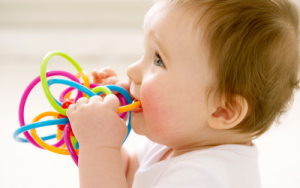
Teething is a key stage in every child’s life, but getting through it can be painful for children and worrying for parents. Most babies’ first teeth come through at around six to nine months, although teething symptoms will often begin a few months before you can see the first tooth appear. Usually, teeth will grow in pairs, most commonly starting with the two bottom front teeth. By the time children are between two and a half to three years old, they should have a full set of teeth.
Key points
- Teething symptoms may include a raised temperature, reddened cheeks which may be warm, reddened gums, excessive dribbling which may cause a rash on the baby’s chin, poor appetite, chewing, restlessness and irritability
- Chewing on something can be a great distraction for your child, but a teething ring will also ease a baby’s discomfort. Teething rings can be cooled in the fridge as this will sooth babies’ gums
- It is a good idea to get your children used to visiting the dentist early, from when the first teeth appear. Speak to your dentist for further information
How to ease teething symptoms
Teething Gels – These usually contain antiseptic and anaesthetic which work by relieving the pain and preventing infection. The effects tend to last about 20 minutes, but can only be used several times a day, so always read the instructions. Ensure that you buy teething gel that is specifically for babies, as adult teething gels are not suitable for children. Consult your pharmacist for more information.
Teething granules or powder – Homeopathic teething remedies which some parents find helpful, particularly for babies waking at night with teething trouble. Larger High Street chemists should stock these.
Teething Rings – Chewing on something can be a great distraction for your child, but a teething ring will also ease a baby’s discomfort. Teething rings can be cooled in the fridge as this will sooth babies’ gums, however, teething rings should never be put it in the freezer as it can damage a baby’s mouth if it becomes too cold and hard. You should never tie a teething ring around a baby’s neck, as it can be a choking hazard. Ensure that you read the instructions before use. Solid silicone-based teething rings are recommended over liquid-filled products as these may leak and can’t be sterilised. You could also use a cold spoon or a clean finger to relieve the pain temporarily.
Affection – Sometimes there’s nothing like a cuddle to distract your baby from the pain. Holding or playing with babies should divert their attention. This may not always work if the baby is restless or irritable.
Chewing – One of the main signs that your child is teething is chewing. Children may chew on anything from their fingers to their toys. Give them something healthy to chew, such as raw fruit or vegetables, but make sure that they are never unsupervised while eating.
Medicine – Infant paracetamol can be helpful for relieving pain. Buy sugar-free in order to protect your child’s teeth. Always check the dosage instructions, and consult your pharmacist if you need more information.
Cool Drinks – Cool drinks will help to soothe children’s gums. The best option is water, although any sugar-free drink will work. This can also help with excessive dribbling.
Preventing rashes – Babies will tend to dribble more when they are teething. Some dribble almost constantly, soaking their clothes. Gently wipe the moisture off your baby’s chin as often as you can with a soft cotton cloth. Be careful not to rub the chin as it may be sore and irritable for your baby. You could also gently rub in a barrier cream such as petroleum jelly on her chin. This will protect her skin from further irritation. Put some on at bedtime and before you take her out and about to protect the soreness from the elements.
Other Symptoms – Sometimes symptoms of other infection or viruses can be confused with teething. Fever or diarrhoea are not usually connected to teething, and could be the result of something else. If you are concerned, contact your GP or contact NHS 111 online.